Mortgage Calculator
Estimate your monthly mortgage payment in seconds, principal, interest, property taxes, insurance, PMI and HOA, with a full amortization schedule. Free, private, and ad-free.
Calculate your monthly mortgage payment
Mortgage rates by state, interactive comparison
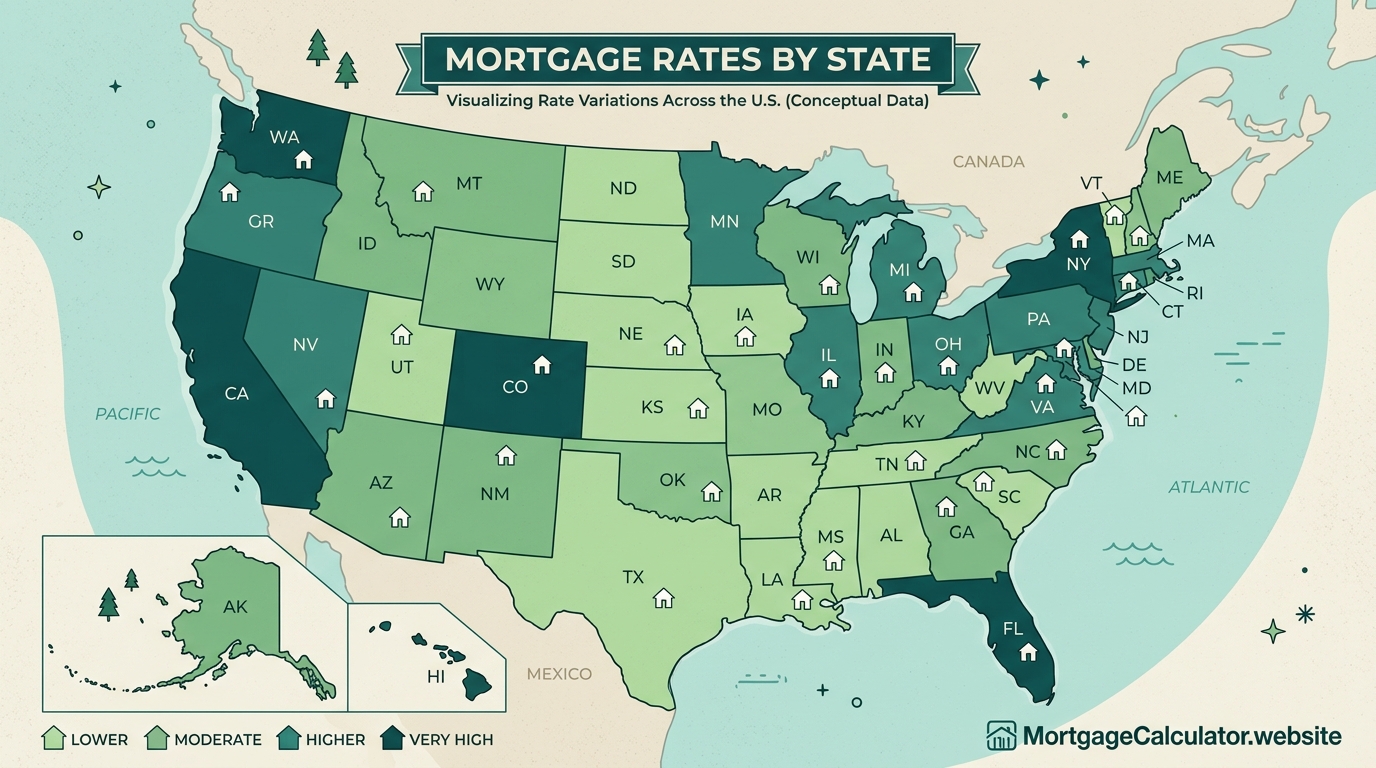
Compare representative 30-year and 15-year mortgage rates across all 50 states, then pick a state to estimate a payment on its typical home price. Click any bar, or choose a state below, and the calculator updates instantly.
Point at a state on the map to see its rates; click a state to load it into the calculator.
Show ranked bar chart
Rates shown are representative figures for illustration and comparison, updated 2026-07-24. They are not a live quote or an offer. Your actual rate depends on your credit, down payment, and lender. To display a live feed, publish /assets/data/rates.json and this chart will use it automatically (see the deployment guide).
Popular calculators
HELOC Payment Calculator
A HELOC payment calculator estimates two things: how large a home equity line of credit you can open (your…
FHA Loan Calculator
An FHA mortgage calculator estimates the monthly payment on a loan backed by the Federal Housing…
Debt-to-Income Calculator
A debt-to-income (DTI) calculator divides your monthly debt payments by your gross monthly income to produce…
Rent vs Buy Calculator
A rent vs buy calculator compares the total cost of renting to the cost of owning over the time you expect to…
Pre-Approval Calculator
A mortgage pre-approval calculator estimates how much a lender may let you borrow by working backward from…
Refinance Calculator
A refinance calculator compares your current mortgage payment to a new loan and shows your monthly savings…
Cash-Out Refinance Calculator
A cash-out refinance calculator estimates how much money you can withdraw by replacing your mortgage with a…
ARM Calculator
An ARM calculator estimates payments on an adjustable-rate mortgage, which has a fixed introductory rate for…
Home Equity Loan Calculator
A home equity loan calculator estimates the lump sum you can borrow against your equity and the fixed monthly…
Mortgage Recast Calculator
A mortgage recast calculator shows how much your monthly payment drops when you make a large lump-sum…
How this mortgage calculator works
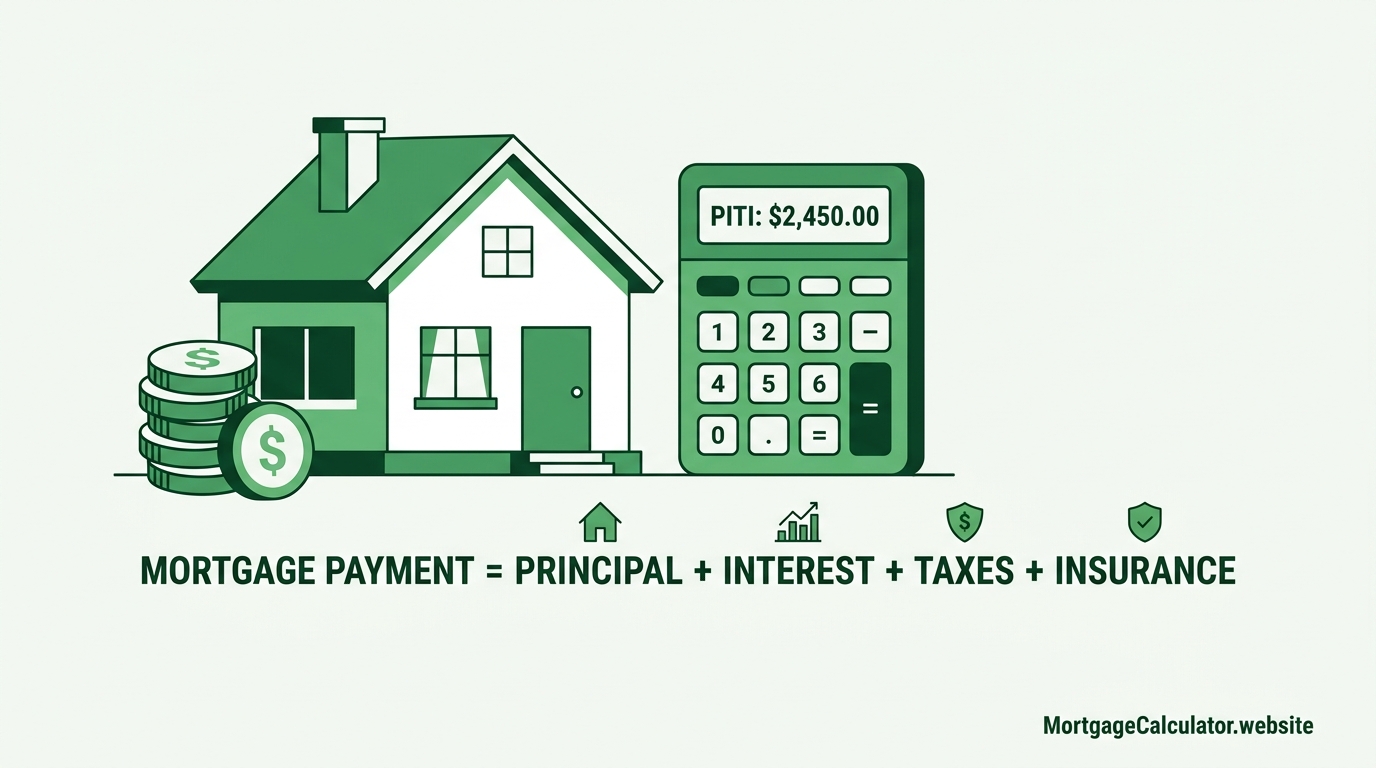
Our calculator uses the standard amortization formula that every U.S. lender relies on. Your principal and interest payment is fixed for the life of a fixed-rate loan and is derived from three numbers: the amount you borrow, the monthly interest rate (your annual rate divided by 12), and the number of monthly payments (your term in years multiplied by 12).
The formula is M = P × r × (1 + r)n ÷ [(1 + r)n − 1], where M is the monthly principal-and-interest payment, P is the loan principal, r is the monthly interest rate, and n is the total number of payments. You never have to touch that formula, the calculator does it for you and then layers on taxes, insurance, PMI and HOA to show your complete monthly cost.
Everything runs locally in your browser. We do not send your figures to a server, we do not ask for your email, and there are no ads pushing you toward a particular lender. That is a deliberate design choice: a mortgage estimate should be a neutral, private starting point, not a lead-capture form.
What is PITI? The four parts of your payment

Most buyers focus only on principal and interest, then get surprised at closing when the real payment is 25–35% higher. A complete payment has four parts, remembered by the acronym PITI:
- Principal, the portion that pays down your loan balance. Early in the loan this is small; it grows every month.
- Interest, the lender's charge for borrowing. Early payments are mostly interest, which is why extra principal payments in year one save so much.
- Taxes, property taxes assessed by your county, usually collected monthly into an escrow account. The national effective average is roughly 0.9–1.1% of home value per year, but it ranges from about 0.3% (Hawaii) to over 2% (New Jersey, Illinois).
- Insurance, homeowners insurance, also usually escrowed. Budget roughly 0.3–0.5% of the home's value annually, more in areas prone to storms, wildfire or flood.
Two extras often ride along: PMI (private mortgage insurance) when your down payment is under 20% on a conventional loan, and HOA dues for condos and planned communities. Our calculator includes fields for both so your estimate matches reality.
How much house can you afford?
Affordability is driven less by the sticker price and more by your debt-to-income ratio (DTI). Lenders compare your total monthly debt payments to your gross monthly income. The widely used guideline is the 28/36 rule: keep housing costs at or below 28% of gross income, and total debts at or below 36%. Government-backed loans stretch further, FHA and many automated approvals allow a back-end DTI up to 43–50% with compensating factors.
A practical way to work backwards is with our pre-approval calculator, which converts your income, existing debts and target rate into a maximum home price. Then confirm the monthly number here, taxes and insurance included. If the payment feels tight, three levers move it most: a larger down payment, a lower rate (via credit improvement or points), or a longer term.
How your interest rate is set
The rate you are offered is not a single national number, it is priced to you. Lenders start from the broad market (heavily influenced by the 10-year Treasury yield and mortgage-backed-securities pricing) and then adjust for your profile. The biggest personal factors are your credit score, your down payment / loan-to-value ratio, the loan type (conventional, FHA, VA, USDA, jumbo), the property type, and whether you buy discount points.
The difference is real money. On a $320,000 loan, moving from a 7.0% to a 6.5% rate cuts principal and interest by roughly $105 a month, about $38,000 over 30 years. Because the rate matters so much, it is worth getting quotes from at least three lenders on the same day and comparing the APR, which folds in fees, not just the headline rate.
15-year vs 30-year: choosing your term

The loan term is the single biggest lever on lifetime cost. A 30-year loan gives you the lowest monthly payment and the most flexibility, which is why it is the default for most buyers. A 15-year loan carries a higher monthly payment but a lower interest rate and dramatically less total interest, often less than half.
Consider a $320,000 loan. At 6.5% over 30 years you pay about $2,022 a month and roughly $408,000 in interest. At 5.9% over 15 years you pay about $2,676 a month but only about $161,000 in interest, a lifetime saving near $247,000. The trade-off is cash-flow flexibility: a 30-year loan lets you pay extra voluntarily in good months, while a 15-year loan locks in the higher payment. Try both terms in the calculator above to see your own numbers.
Down payments, PMI, and the 20% myth
You do not need 20% down to buy a home. Conventional loans go as low as 3%, FHA as low as 3.5%, and VA and USDA loans can require nothing down for eligible borrowers. The catch with less than 20% down on a conventional loan is PMI, typically 0.3–1.5% of the loan per year, added to your monthly payment.
The good news: conventional PMI is not permanent. Under the federal Homeowners Protection Act you can request cancellation once you reach 20% equity, and it automatically terminates at 22%. FHA mortgage insurance behaves differently and often lasts the life of the loan unless you refinance. If you are weighing a smaller down payment against waiting to save more, model both scenarios, the calculator shows exactly how much PMI adds each month.
Ways to lower your monthly payment
If your estimate is higher than you would like, these are the highest-impact moves, roughly in order:
- Improve your credit score before applying, even a 20–40 point jump can move you into a better rate tier.
- Shop at least three lenders and compare APRs on the same day; pricing varies more than most buyers expect.
- Increase your down payment to cross the 20% threshold and eliminate PMI.
- Consider discount points if you will stay in the home long enough to break even on the upfront cost.
- Extend the term to 30 years for a lower payment, or make extra principal payments later to shorten it back up.
- Appeal your property tax assessment if it looks high for comparable homes, it directly lowers the escrow portion.
After closing, keep an eye on rates. If they fall meaningfully, our refinance calculator shows whether refinancing beats your closing costs and how long the break-even takes.
Why buyers trust MortgageCalculator.website
We built this tool around three principles the big ad-heavy calculators often ignore. First, completeness: our default estimate is full PITI, not a stripped-down principal-and-interest figure that understates your real cost. Second, privacy: every calculation happens on your device, so your salary and home price never leave your browser. Third, clarity: no pop-ups, no forced lead forms, and a plain-English breakdown of where every dollar goes.
Our figures follow the same standards lenders and regulators use. Payment math uses the industry-standard amortization formula; guidance references public material from the Consumer Financial Protection Bureau (CFPB), Fannie Mae, Freddie Mac, HUD/FHA, and the IRS. When rules change, conforming loan limits, FHA insurance factors, tax treatment, we update the relevant pages and note the date.
A mortgage calculator with taxes, insurance, and PMI, not just principal and interest
Here is where most calculators quietly mislead you. Type a price and a rate into a typical tool and it shows a tidy principal-and-interest number, then reality arrives 25 to 35 percent higher once the escrow bill lands. Our mortgage calculator includes taxes, insurance, PMI, and HOA by default, because those are not optional extras; they are your payment.
Think of it this way. On a $400,000 home, principal and interest might be around $2,000 a month, but property taxes can add $250–$700 depending on your state, homeowners insurance another $100–$200, and PMI another $100–$250 if you put less than 20 percent down. That is potentially $650 or more per month the "simple" calculators leave out. When you are deciding whether a home fits your life, that gap is the difference between comfortable and stretched. Enter your real local figures above and you will see the honest number, the one your lender will quote and your budget will actually feel.
Extra payment calculator: how a little more each month changes everything
One of the most powerful, and most overlooked, moves in personal finance is the humble extra mortgage payment. Because early payments are mostly interest, every extra dollar of principal you pay in the first years erases a disproportionate amount of future interest. It is the closest thing to a guaranteed, tax-free return most homeowners will ever find.
Run the scenario in the calculator above and the amortization schedule tells the story. Consider a $320,000 loan at 6.5 percent over 30 years:
- Add $100 a month and you can shave roughly three years off the loan and save tens of thousands in interest.
- Add $250 a month and you might cut five to seven years and save well over $80,000.
- Make one extra full payment a year (or pay biweekly) and you typically knock four to five years off a 30-year term.
The beauty is the flexibility: unlike choosing a 15-year loan, which locks you into a higher payment, extra payments on a 30-year loan are voluntary. Pay more in good months, drop back to the minimum when money is tight. Just confirm your loan has no prepayment penalty, rare on standard U.S. mortgages, and that extra amounts are applied to principal, not prepaid toward next month.
What has changed for home buyers, and why old advice can cost you
A lot of the mortgage advice still floating around the internet was written for a very different market, and following it today can quietly cost you money. Here is what is genuinely different now, and how to adjust.
The "just refinance later" assumption is riskier
For years, buyers were told to accept any rate because they could simply refinance when rates dropped. In a higher-rate environment that is no longer a safe bet, rates may not fall on your timeline. Choose a payment you can afford at today's rate, and treat a future refinance as a bonus, not a plan. Our refinance calculator will tell you if and when it actually pays off.
ARMs are worth a second look, carefully
When fixed rates were near historic lows, adjustable-rate mortgages made little sense. With the gap between intro ARM rates and fixed rates wider again, ARMs have returned as a legitimate option for buyers with a shorter time horizon, provided you understand the caps and can afford the worst-case reset. Model both in our ARM calculator before deciding.
Loan limits and costs keep rising
Conforming loan limits are adjusted upward most years as home prices climb, which changes where jumbo pricing kicks in. Property taxes and especially homeowners insurance have risen sharply in many regions. Advice that quotes old limits or assumes cheap insurance understates your real cost, always use current, local figures, which is exactly what the calculator above lets you do.
What salary do you need to afford a home?
Buyers constantly ask it backwards, "what's the payment on this house?", when the more useful question is "what home fits my income?" The answer flows from the same debt-to-income math lenders use, and you can estimate it in seconds.
A common guideline keeps your total housing payment near 28 percent of gross monthly income. Working from that:
- A $60,000 salary (~$5,000/mo) supports roughly a $1,400 housing payment, often a home in the low-to-mid $200,000s depending on rates, taxes, and down payment.
- A $100,000 salary (~$8,300/mo) supports roughly a $2,300 payment, frequently a home in the $350,000–$400,000 range.
- A $150,000 salary (~$12,500/mo) supports roughly a $3,500 payment, often a home in the $550,000–$600,000 range.
These are illustrations, not promises, your rate, existing debts, down payment, and local taxes all move the number. Existing debt is the biggest swing factor: a large car payment or student loan can cut your buying power sharply because it eats into the same debt-to-income budget. Our pre-approval calculator turns your exact income and debts into a personalized maximum, and the DTI calculator shows how paying down a debt lifts your ceiling.
40-year, 50-year, and other longer-term mortgages
As affordability has tightened, longer loan terms have entered the conversation. A 40-year mortgage, and even the occasionally discussed 50-year mortgage, spreads repayment over more years to shrink the monthly payment. The appeal is obvious; the trade-off is steep.
Stretching the term lowers your monthly cost but dramatically increases total interest, and you build equity far more slowly because more of each early payment goes to interest. On a $320,000 loan, moving from 30 to 40 years might trim a couple hundred dollars off the monthly payment while adding well over $100,000 in lifetime interest. These longer terms are usually non-qualified-mortgage products with fewer consumer protections, and they are not offered by every lender. For most buyers, a 30-year loan with the option to make extra payments is a better balance, you get the low required payment when you need it and the ability to pay down faster when you can. Test any term in the calculator above and watch the total-interest figure, not just the monthly number.
Reverse mortgages and options for older homeowners
Homeowners aged 62 and older have an option younger buyers do not: a reverse mortgage, which lets you convert home equity into cash without a monthly mortgage payment. Instead of you paying the lender, the lender pays you, as a lump sum, monthly income, or line of credit, and the balance is repaid when you sell, move out, or pass away.
The most common type is the federally insured Home Equity Conversion Mortgage (HECM). Reverse mortgages can be a valuable tool for supplementing retirement income while staying in your home, but they carry meaningful costs and reduce the equity you leave to heirs, so they deserve careful thought and ideally independent counseling (required for HECMs). You must also keep up with property taxes, insurance, and maintenance to stay in good standing. If you are weighing one, understand the fees, the growth of the loan balance over time, and the alternatives, such as downsizing or a home equity loan, before committing.
The complete home-buying process, step by step

A mortgage does not exist in isolation, it sits inside the larger process of buying a home. Understanding where the calculator fits helps you use it at the right moments. Here is the full journey most U.S. buyers follow, from first thought to move-in day.
- Check your finances. Pull your credit reports, tally your debts, and estimate your budget. Use this mortgage calculator and our debt-to-income calculator to see what a comfortable payment looks like.
- Save for the down payment and closing costs. Aim for your target down payment plus 2–5% of the price for closing costs and a cash reserve for moving and repairs.
- Get pre-approved. Apply with one or more lenders so you know your true budget and can make credible offers. Our pre-approval calculator estimates this in advance.
- Shop for a home. Work with an agent, tour homes, and keep your target payment in mind rather than the maximum you were approved for.
- Make an offer and go under contract. Negotiate price and terms; your earnest-money deposit signals you are serious.
- Complete the mortgage application. Provide income, asset, and employment documentation for full underwriting.
- Get an appraisal and inspection. The lender confirms the home's value; the inspection protects you from costly surprises.
- Clear underwriting conditions. Respond quickly to document requests and avoid new credit or job changes.
- Close. Review your Closing Disclosure, bring your funds, sign, and receive the keys.
The whole process typically takes 30–45 days from accepted offer to closing, though pre-approval and house-hunting can add weeks or months before that.
Types of mortgage loans compared
The loan program you choose shapes your down payment, your rate, your mortgage insurance, and even which homes you can buy. Here are the five main options and who each suits best.
Conventional loans
Not backed by the government and the most common choice. They allow down payments as low as 3%, and their private mortgage insurance is cancellable once you reach 20% equity. Best for borrowers with solid credit (roughly 620+, ideally 680+) who want flexibility and the ability to shed mortgage insurance later.
FHA loans
Insured by the Federal Housing Administration, with down payments from 3.5% and more forgiving credit requirements. The trade-off is mortgage insurance that often lasts the life of the loan. Best for first-time buyers or those with lower credit scores or smaller down payments. Estimate one with our FHA calculator.
VA loans
Guaranteed by the Department of Veterans Affairs for eligible service members, veterans, and surviving spouses. They can require zero down payment and charge no monthly mortgage insurance, making them one of the most affordable options available. A one-time funding fee usually applies.
USDA loans
Backed by the U.S. Department of Agriculture for eligible rural and some suburban buyers. They offer zero-down financing with income limits and geographic eligibility rules. Best for moderate-income buyers purchasing in qualifying areas.
Jumbo loans
For loan amounts above the annual conforming limit set by the Federal Housing Finance Agency. They typically require stronger credit, larger down payments, and more cash reserves because they cannot be sold to Fannie Mae or Freddie Mac. Best for buyers in high-cost markets or purchasing luxury properties.
How your credit score affects your mortgage rate
Your credit score is one of the biggest levers on the rate you are offered, and therefore on your monthly payment. Lenders price loans in tiers, and moving up even one tier can save tens of thousands over the life of a loan. While exact pricing varies by lender and market, the general relationship looks like this:
- 760–850 (excellent): the best available rates and lowest fees.
- 700–759 (very good): rates only slightly above the top tier.
- 680–699 (good): competitive conventional pricing.
- 640–679 (fair): noticeably higher rates; FHA may be more attractive.
- 580–639 (poor): limited options, higher rates; FHA with 3.5% down is often the path.
- Below 580: conventional and standard FHA become difficult; focus on rebuilding credit first.
Before applying, you can raise your score by paying down credit-card balances (which lowers your utilization ratio), correcting errors on your credit reports, keeping old accounts open, and avoiding new credit inquiries. Even a 20–40 point improvement can shift you into a better pricing tier and lower the payment this calculator shows.
Down payment strategies and assistance
The down payment is often the single biggest obstacle to buying, but there are more paths than many buyers realize.
How much to put down
Putting 20% down avoids PMI on a conventional loan and lowers your payment, but tying up all your cash can leave you exposed. Many buyers do better keeping a healthy emergency reserve and paying PMI temporarily, then cancelling it once they reach 20% equity. There is no universally correct answer, model both in the calculator and weigh the payment against your cash cushion.
Down payment assistance programs
Thousands of state, county, and city programs offer grants or low-interest second loans to help with the down payment and closing costs, especially for first-time and moderate-income buyers. Benefits include:
- Grants that never have to be repaid.
- Forgivable loans that dissolve after you live in the home for a set number of years.
- Deferred-payment second mortgages repaid only when you sell or refinance.
Gift funds
Most loan programs allow family members to gift some or all of your down payment, provided the gift is documented with a letter confirming it is not a loan. FHA is especially flexible about gift funds, which is one reason it is popular with first-time buyers.
Closing costs: what you pay beyond the down payment
Closing costs are the fees required to finalize your loan and transfer the property, typically running 2–5% of the purchase price. On a $400,000 home that is roughly $8,000–$20,000 on top of your down payment. They generally fall into a few categories:
- Lender fees: loan origination, underwriting, and processing charges.
- Third-party fees: appraisal, credit report, title search, and title insurance.
- Prepaid items: homeowners insurance, property taxes, and prepaid interest collected in advance.
- Escrow setup: initial deposits into your escrow account for future taxes and insurance.
- Government charges: recording fees and any transfer taxes.
You can reduce closing costs by comparing Loan Estimates from multiple lenders, negotiating certain fees, asking the seller for a closing-cost credit, or choosing a lender credit that trades a slightly higher rate for lower upfront costs. Always review your official Loan Estimate within three business days of applying, and compare it to the final Closing Disclosure you receive before signing.
How escrow accounts work
Most mortgages include an escrow (or impound) account that spreads your property taxes and homeowners insurance across twelve monthly payments instead of hitting you with large annual bills. Each month, part of your payment goes into escrow; when taxes and insurance come due, the lender pays them on your behalf.
Escrow protects both you and the lender: you avoid a surprise four-figure tax bill, and the lender ensures the taxes and insurance that protect its collateral are always paid. Once a year, the servicer performs an escrow analysis to check whether your account is on track. If taxes or insurance premiums rose, you may face an escrow shortage and a higher monthly payment; if they fell, you might receive a refund. This is why your total payment can change over time even on a fixed-rate loan, the principal and interest stay constant, but the tax and insurance portions adjust. Our calculator's separate fields for taxes and insurance let you see exactly how much of your payment is escrow versus loan repayment.
Property taxes and homeowners insurance by region
Two of the four PITI components, taxes and insurance, vary enormously by location, and they can make identical homes cost very different amounts to own.
Property taxes
Property taxes are set locally and expressed as an effective rate on your home's assessed value. The national average effective rate is roughly 0.9–1.1% per year, but the range is wide:
- Low (under 0.6%): Hawaii, Alabama, Colorado, and several western and southern states.
- Moderate (0.8–1.3%): much of the country.
- High (over 1.8%): New Jersey, Illinois, Connecticut, and parts of the Northeast and Texas.
On a $400,000 home, the difference between a 0.5% and a 2.1% rate is about $530 a month, larger than many buyers expect.
Homeowners insurance
Insurance costs depend on the home's value, construction, and local risk. Coastal areas exposed to hurricanes, wildfire-prone regions, and hail-belt states carry higher premiums, and some high-risk areas require separate flood or wind policies. Budget roughly 0.3–0.5% of the home's value per year as a starting point, and get real quotes before you commit, since premiums have risen sharply in many markets.
Understanding PMI and how to remove it
Private mortgage insurance protects the lender, not you, when your down payment is under 20% on a conventional loan. It typically costs 0.3–1.5% of the loan amount per year, added to your monthly payment, with the exact rate depending on your credit score and down payment.
How to get rid of conventional PMI
- Reach 20% equity and request cancellation. Under the federal Homeowners Protection Act, you can ask your servicer to cancel PMI once your balance falls to 80% of the original value.
- Wait for automatic termination. PMI ends automatically when your balance reaches 78% of the original value, provided you are current.
- Get a new appraisal. If your home has appreciated, a new appraisal showing 20%+ equity can let you cancel sooner.
- Refinance. If you have gained substantial equity, refinancing into a new loan without PMI may make sense, check the math with our refinance calculator.
FHA mortgage insurance works differently: on most modern FHA loans it lasts the life of the loan, and the common way to remove it is to refinance into a conventional loan once you have enough equity.
Amortization, extra payments, and paying off early

Amortization is the schedule by which your loan balance is paid down over time. Its most important feature surprises many first-time buyers: early payments are mostly interest, and only later do they become mostly principal. On a 30-year loan at 6.5%, roughly two-thirds of your first payment goes to interest, not to reducing what you owe.
This front-loading is exactly why extra principal payments early in the loan are so powerful, every extra dollar skips all the future interest it would have accrued.
Strategies to pay off faster
- One extra payment a year: making 13 payments instead of 12 can cut a 30-year loan by roughly four to five years.
- Biweekly payments: paying half your monthly amount every two weeks results in 26 half-payments, one extra full payment a year, with the same effect.
- Rounding up: adding even $50–$100 to each payment steadily shortens the term.
- Lump sums: applying a bonus or tax refund directly to principal removes future interest immediately.
Before committing to extra payments, confirm your loan has no prepayment penalty (rare on standard U.S. mortgages) and make sure the extra amount is applied to principal, not next month's payment. Weigh early payoff against other goals, too, if your mortgage rate is low, investing or paying off higher-interest debt first may serve you better.
Discount points and rate buydowns
A discount point is a fee you pay the lender at closing to permanently lower your interest rate, one point costs 1% of the loan amount and typically reduces the rate by about 0.25%. Points make sense when you plan to keep the loan long enough to recoup the upfront cost through lower payments.
To decide, calculate the break-even: divide the cost of the points by the monthly savings they produce. If two points cost $6,400 and save $95 a month, you break even in about 67 months, a bit under six years. Stay past that and points pay off; sell or refinance sooner and they do not. A temporary buydown (such as a 2-1 buydown) instead lowers your rate for the first year or two before it steps up to the note rate, and is often paid for by a seller or builder as an incentive. Both tools can help, but only if the math fits your timeline, model the payment difference in the calculator above.
Programs and tips for first-time home buyers

First-time buyers, generally defined as anyone who has not owned a primary residence in the past three years, have access to programs specifically designed to lower the barriers to ownership.
- Low-down-payment loans: conventional 3%-down programs, FHA 3.5%-down loans, and zero-down VA and USDA loans for eligible buyers.
- Down payment assistance: state and local grants and forgivable second loans, as described above.
- Mortgage Credit Certificates (MCCs): a federal tax credit for a portion of mortgage interest, offered through many state housing agencies.
- Homebuyer education courses: often required for assistance programs, and genuinely useful for understanding the process.
Beyond programs, the most valuable first-time-buyer habits are simple: get pre-approved before shopping, buy well within your budget rather than at your maximum, keep a cash reserve for the inevitable surprises of homeownership, and resist the urge to make big purchases or open new credit during the loan process. The calculator above is your friend here, run several realistic scenarios so you walk into the market knowing exactly what payment you are comfortable with.
Common mortgage mistakes to avoid
Even well-prepared buyers make avoidable errors. Watching for these can save you money and stress:
- Shopping homes before getting pre-approved. You risk falling for a home you cannot finance or losing out to prepared buyers.
- Focusing only on principal and interest. Taxes, insurance, PMI, and HOA dues can add 25–35%, always budget the full PITI.
- Not comparing lenders. Rates and fees vary meaningfully; getting three quotes on the same day can save thousands.
- Making big purchases during underwriting. A new car loan or furniture on credit can change your DTI and derail approval.
- Draining every dollar into the down payment. Keep a reserve for moving, repairs, and emergencies.
- Ignoring the loan term trade-off. A 30-year loan lowers the payment but costs far more interest than a 15-year loan.
- Skipping the inspection. Waiving it to win a bid can lead to expensive surprises.
- Not reading the Closing Disclosure. Review it against your Loan Estimate and question any changes before signing.
Most of these mistakes come down to acting on incomplete information. Using a complete-cost calculator, getting pre-approved, and comparing lenders addresses the majority of them.
Fixed-rate vs adjustable-rate: a closer look
Beyond the term length, you will choose between a fixed and an adjustable rate. A fixed-rate mortgage keeps the same interest rate, and the same principal-and-interest payment, for the entire loan, giving you certainty and protection from rising rates. It is the right choice for most buyers, especially those planning to stay long-term.
An adjustable-rate mortgage (ARM) offers a lower rate for an introductory period (often 5, 7, or 10 years) before adjusting periodically based on a market index. ARMs can save money if you expect to move or refinance before the fixed period ends, or if intro rates are meaningfully below fixed rates. The risk is payment uncertainty once the loan adjusts, which is why our ARM calculator shows both the intro payment and the worst-case capped payment. As a rule, choose fixed for certainty and long horizons, and consider an ARM only when you have a clear, shorter time frame and can afford the potential increase.
When and how to refinance later
Your first mortgage does not have to be your last. Refinancing replaces your existing loan with a new one, and it can make sense when rates fall, when your credit improves, when you want to change your term, or when you need to eliminate FHA mortgage insurance. The key test is the break-even point: divide your closing costs by your monthly savings to see how many months it takes to recoup the cost. If you will stay in the home past that point, refinancing pays off.
Be careful with two things. First, refinancing a loan you have paid down for years into a fresh 30-year term can raise your total interest even at a lower rate, consider a shorter new term to stay on schedule. Second, factor in all closing costs, not just the rate. Our refinance calculator and cash-out refinance calculator handle both scenarios, and our HELOC and home equity loan tools cover tapping equity without disturbing a low first-mortgage rate.
VA and USDA loans: zero-down options
Two government-backed programs allow eligible buyers to purchase with no down payment, which can be the difference between renting for years and owning now.
VA loans
Guaranteed by the Department of Veterans Affairs, VA loans are available to eligible active-duty service members, veterans, and some surviving spouses. Their advantages are substantial: zero down payment, no monthly mortgage insurance, competitive rates, and limits on the fees you can be charged. A one-time VA funding fee applies (which can be financed or waived for those with a service-connected disability). For those who qualify, a VA loan is often the single most affordable path to ownership.
USDA loans
Backed by the U.S. Department of Agriculture, USDA loans support homeownership in eligible rural and many suburban areas. They offer zero-down financing with modest guarantee fees, but come with two key rules: the property must be in a USDA-eligible location, and your household income must fall under the area limit. Many buyers are surprised how many towns just outside major metros qualify. If you're buying outside a dense city core, it's worth checking eligibility before assuming you need a down payment.
Understanding HOA fees
If you buy a condo, townhouse, or a home in a planned community, you'll likely pay homeowners association (HOA) dues, a recurring fee that funds shared amenities and maintenance. HOA fees range from a modest $20–$50 a month for a basic single-family neighborhood to several hundred, or even over a thousand, for condos with elevators, pools, gyms, and concierge services.
HOA dues matter to your mortgage in two ways. First, they're part of your true monthly housing cost, so lenders include them in your debt-to-income calculation, a high HOA fee can reduce how much home you qualify for. Second, they're not optional and can rise over time or trigger special assessments for major repairs. Before buying in an HOA community, review the association's budget, reserves, rules, and history of fee increases. Enter the monthly figure in the HOA field of the calculator above so your payment estimate reflects the real cost of the specific property.
Understanding your Loan Estimate and Closing Disclosure
Two standardized documents protect you during the mortgage process, and knowing them prevents costly surprises. Within three business days of applying, every lender must give you a Loan Estimate, a three-page form showing your estimated rate, monthly payment, closing costs, and key loan features in a format designed for easy comparison between lenders. Collect Loan Estimates from several lenders on the same day and compare them line by line.
At least three business days before closing, you receive the Closing Disclosure, a similar five-page form showing the final, actual terms and costs. Your job is to compare the two: the Closing Disclosure should closely match your Loan Estimate. Certain costs cannot legally increase at all, others only within limits. If a number jumped without explanation, ask before you sign, that three-day window exists precisely so you can review and question the final terms.
How lenders verify your income and assets
Underwriting is where a lender confirms you can repay the loan. Understanding what they check helps you prepare a clean file and avoid delays.
- Income: recent pay stubs, the last two years of W-2s or tax returns, and sometimes a verification of employment. Self-employed borrowers provide business returns and profit-and-loss statements.
- Assets: two months of bank and investment statements to confirm your down payment and reserves, and to source any large deposits.
- Credit: a full credit report and score, plus explanations for any recent issues.
- Debts: all monthly obligations, used to compute your debt-to-income ratio.
- Property: an appraisal to confirm the home's value supports the loan.
The most common cause of delays is large, unexplained deposits or new debts appearing mid-process. Keep your finances stable from application to closing: don't change jobs, open new credit lines, make big purchases, or move money around without documenting it. A well-prepared file often closes faster and with fewer conditions.
Locking your interest rate
A rate lock guarantees your quoted interest rate for a set period, commonly 30, 45, or 60 days, while your loan is processed, protecting you if rates rise before closing. If rates fall significantly after you lock, some lenders offer a one-time "float-down" option, though it may cost extra.
The timing matters. Lock too early and you may pay for an extension if closing slips; lock too late and you risk a rate increase. As a rule, lock once you're under contract on a specific home and confident of your closing timeline. Ask your lender how long the lock lasts, what an extension costs, and whether a float-down is available. Because even a quarter-point swing changes your payment and total interest, treat the lock decision as seriously as choosing the loan itself, and use the calculator above to see exactly what a rate change is worth over the life of your loan.
The home appraisal and what happens if it comes in low
Your lender orders an independent appraisal to confirm the home is worth what you're paying, because the property secures the loan. Usually the appraisal supports the price and the loan proceeds normally. Occasionally it comes in below the contract price, which creates a gap because the lender will only lend against the appraised value, not the higher price.
If that happens, you have several options: negotiate with the seller to lower the price to the appraised value, split the difference, pay the gap in cash, challenge the appraisal with better comparable sales, or, if your contract has an appraisal contingency, walk away and recover your deposit. A low appraisal is stressful but rarely fatal to a deal; it simply forces a renegotiation. Knowing your options in advance keeps you calm and in control if it occurs.
Is mortgage interest tax-deductible?
For many homeowners who itemize, mortgage interest is tax-deductible, which can meaningfully lower the after-tax cost of owning. Under current federal rules, you can generally deduct interest on up to $750,000 of mortgage debt used to buy, build, or substantially improve your primary or second home ($1 million for loans originated before the 2018 change). Points paid to obtain the loan and property taxes may also be deductible, subject to limits.
The catch is that the deduction only helps if your total itemized deductions exceed the standard deduction, which is relatively high, so many homeowners with smaller loans take the standard deduction instead and see no direct tax benefit from their mortgage interest. The rules are nuanced and change over time, and your benefit depends on your income, filing status, and loan size. Treat any tax saving as a bonus rather than a reason to buy, and confirm your specific situation with a qualified tax professional or the IRS guidance directly.
How to compare mortgage lenders and get the best rate
The rate and fees you are offered can vary more between lenders than most buyers imagine, often enough to change your payment by hundreds of dollars a month and your lifetime cost by tens of thousands. Shopping around is the single highest-paid hour of work in the entire home-buying process, yet many buyers get just one quote. Do not be one of them.
A simple lender-comparison routine
- Get quotes from at least three lenders on the same day. Rates move daily, so same-day quotes are the only fair comparison. Include a mix, a big bank, a credit union, and an online lender or broker.
- Compare the APR, not just the rate. APR folds in fees, so it reveals the true cost of a low "teaser" rate that hides high closing costs.
- Line up the Loan Estimates. This standardized form makes side-by-side comparison easy, check the rate, monthly payment, and total closing costs boxes.
- Ask about points and credits. One lender's lower rate may simply reflect points you are paying for; another's higher rate may come with a credit toward closing costs.
- Negotiate. Lenders can and do match or beat competitors. A better written offer is real leverage.
Rate shopping will not hurt your credit if you keep it inside a focused window, the credit bureaus treat multiple mortgage inquiries within roughly 14 to 45 days as a single event. So gather your quotes quickly, plug each rate into the calculator above to see the real payment difference, and let the numbers pick your lender.
Common mortgage myths, debunked
Persistent myths cause buyers to overpay, wait too long, or rule themselves out unnecessarily. Here are the ones worth unlearning.
- "You need 20% down." False. Conventional loans go to 3%, FHA to 3.5%, and VA and USDA can be zero down. Twenty percent avoids PMI, but it is not a requirement to buy.
- "Pre-qualification means you're approved." No. Pre-qualification is an unverified estimate; a verified pre-approval is what carries weight with sellers.
- "The lowest rate is always the best deal." Not necessarily, a low rate bought with high points or fees can cost more than a slightly higher rate with lower closing costs. Compare APRs.
- "Checking your rate wrecks your credit." Rate shopping within a short window counts as a single inquiry and has minimal impact.
- "Renting is throwing money away." Sometimes renting genuinely wins, for short stays or in high price-to-rent markets. Run the numbers in our rent vs buy calculator rather than assuming.
- "You should always pay off your mortgage as fast as possible." It depends. If your rate is low, investing or clearing higher-interest debt first may build more wealth. Weigh the trade-off against your goals.
The common thread: replace assumptions with your own numbers. A few minutes in the calculator above, and the tools linked throughout this page, will tell you what is actually true for your situation, which is the only version that matters.
Mortgage terms glossary
A quick reference for the terms you will encounter. Understanding this vocabulary makes every lender conversation easier.
- APR (Annual Percentage Rate): the yearly cost of a loan including fees, useful for comparing offers.
- Amortization: the schedule that pays off your loan through regular payments over time.
- Closing costs: the fees to finalize your loan, typically 2–5% of the price.
- DTI (Debt-to-Income ratio): your monthly debts divided by gross income; a key approval factor.
- Escrow: an account that holds funds for taxes and insurance, paid monthly with your mortgage.
- Equity: the portion of your home you own outright, value minus what you owe.
- LTV (Loan-to-Value): your loan amount divided by the home's value, expressed as a percentage.
- PITI: principal, interest, taxes, and insurance, the four parts of a complete payment.
- PMI: private mortgage insurance, required with under 20% down on a conventional loan.
- Points: upfront fees paid to lower your interest rate.
- Pre-approval: a lender's conditional commitment based on verified finances.
- Principal: the amount you borrow, separate from interest.
- Underwriting: the lender's process of verifying your finances and the property before approval.
Mortgage recast: a low-cost alternative to refinancing
A mortgage recast is one of the most useful tools most homeowners have never heard of. Instead of refinancing into a new loan, you make a large lump-sum payment toward your principal and ask your servicer to re-amortize the remaining balance over your existing term. Your interest rate and loan term stay exactly the same, only the balance shrinks, so your monthly payment drops.
Recast vs refinance
- Cost: a recast usually costs a small flat fee (often $150–$500), versus 2–5% of the loan for a refinance.
- Rate: a recast keeps your current rate, ideal if you already have a low one you don't want to lose. A refinance replaces it, which only helps if rates have fallen.
- Approval: a recast typically needs no credit check, appraisal, or income verification, because you aren't taking a new loan.
- Effect: a recast lowers your payment but keeps your payoff date; extra principal without recasting keeps your payment but shortens the payoff.
When a recast makes sense
Recasting shines when you come into a lump sum, an inheritance, a bonus, or proceeds from selling another property, and you have a good rate you want to keep. You lower your required payment without the cost and paperwork of refinancing. Not all loans are eligible (government-backed FHA, VA, and USDA loans generally cannot be recast), and lenders usually require a minimum lump sum, so ask your servicer first. To compare recasting against a refinance, run both through our refinance calculator and weigh the fee against the monthly savings.
How much is the mortgage on a $200,000, $300,000, or $400,000 home?
One of the most common questions buyers ask is simply what a given price translates to per month. The answer depends on your rate, term, and down payment, but here are illustrative principal-and-interest figures at a 6.5% rate on a 30-year loan with 20% down (taxes and insurance would be added on top):
- $200,000 home ($160,000 loan): roughly $1,011 per month in principal and interest.
- $300,000 home ($240,000 loan): roughly $1,517 per month.
- $400,000 home ($320,000 loan): roughly $2,022 per month.
- $500,000 home ($400,000 loan): roughly $2,528 per month.
- $600,000 home ($480,000 loan): roughly $3,033 per month.
Add property taxes (often $150–$700 a month depending on your state) and homeowners insurance (typically $80–$200 a month) to get your true payment, plus PMI if you put down less than 20%. These round numbers are a helpful starting point, but your own rate and local costs move them meaningfully, enter your exact figures in the calculator above to see a payment tailored to your situation rather than a national average.
Mortgage rates and payments by state
Where you buy changes your payment as much as what you buy. Two forces vary by state: the interest rate (which moves within a narrow band based on local lending competition and risk) and, far more dramatically, home prices, property taxes, and insurance costs. Our interactive rate chart above lets you compare all 50 states and estimate a payment on each state's typical home price.
High-cost vs affordable states
In states like California, Hawaii, Massachusetts, and Washington, typical home prices push payments well above the national average even when rates are similar. In much of the Midwest and South, states like Ohio, Indiana, Mississippi, and West Virginia, lower prices make ownership far more attainable on the same income. Property taxes add another layer: the same $400,000 home costs hundreds more per month in New Jersey or Illinois than in Hawaii or Alabama, purely from the tax rate.
Using the state comparison wisely
If you have flexibility about where to live, remote workers, retirees, or anyone relocating, comparing states can reveal that the same budget buys a dramatically different lifestyle. Use the interactive chart to sort by rate or by price, select your target state, and see an instant payment estimate, then refine it in the full calculator with the exact home price, taxes, and insurance for the specific area you're considering.
Simple, free, and private by design

Searchers often look for a simple or free mortgage calculator, and this is exactly that, with nothing sacrificed. There is no paywall, no account, and no upsell. But "simple" doesn't have to mean "incomplete." We designed the tool so the basic path is effortless, enter a price, a down payment, a rate, and a term, and you have an answer, while the additional fields for taxes, insurance, PMI, and HOA are there when you want a complete, accurate picture.
What "free" should include
- No cost, ever, every calculator on the site is free to use without limits.
- No sign-up, you never have to hand over an email or phone number to see a result.
- No ads in your way, the interface stays clean so you can focus on the numbers.
- No data harvesting, your inputs stay in your browser and are never sold to lenders.
That combination, simple to use, genuinely free, and private, is deliberately different from the lead-generation calculators that dominate search results. You get the full functionality of an advanced tool with the ease of a basic one, and you keep your privacy in the process.
Using this calculator for different scenarios
The calculator above is flexible enough to answer many real questions beyond a single payment. Here are practical ways to use it:
- Compare two homes: run each price and see how the monthly payment and total interest differ.
- Test down-payment sizes: watch how crossing 20% removes PMI and lowers the payment.
- Compare 15 vs 30 years: switch the term to see the payment rise but the total interest fall dramatically.
- Model a rate change: see how much a half-point difference in rate is worth over the life of the loan.
- Budget for taxes and insurance: enter realistic local figures so your estimate reflects true ownership costs.
- Plan extra payments: read the amortization schedule to understand how much interest early principal reductions save.
Because everything recalculates instantly and privately, there is no downside to experimenting. Try a dozen scenarios before you ever talk to a lender, you will arrive far better informed, with a clear sense of the payment and total cost you are comfortable committing to for years to come.
Frequently Asked Questions
How do I calculate my monthly mortgage payment?
Enter the home price, your down payment, the interest rate, and the loan term into the calculator above. It applies the standard amortization formula for principal and interest, then adds property taxes, homeowners insurance, PMI (if your down payment is under 20%), and any HOA dues to show your complete monthly PITI payment.
What is included in a mortgage payment?
A complete mortgage payment has four parts, principal, interest, taxes, and insurance (PITI). If your down payment is under 20% on a conventional loan, private mortgage insurance (PMI) is added, and condos or planned communities add monthly HOA dues.
How much should I put down on a house?
Putting 20% down on a conventional loan avoids PMI, but it is not required. Conventional loans allow as little as 3% down, FHA loans 3.5%, and VA and USDA loans can require nothing down for eligible borrowers. A larger down payment lowers your loan amount, your monthly payment, and often your interest rate.
What interest rate should I use in the calculator?
Use a rate from an actual lender quote if you have one. Otherwise, use today's average rate for your loan type and term as a starting point. Your real rate depends on your credit score, down payment, loan type, and the property. Getting quotes from three lenders on the same day gives the most accurate comparison.
Is a 15-year or 30-year mortgage better?
A 30-year mortgage has a lower monthly payment and more flexibility; a 15-year mortgage has a higher payment but a lower rate and far less total interest, often less than half. The right choice depends on your budget and priorities. Enter both terms in the calculator to compare your own numbers.
When can I stop paying PMI?
On a conventional loan, you can request PMI cancellation once you reach 20% equity, and it terminates automatically at 22% equity under the federal Homeowners Protection Act. FHA mortgage insurance often lasts the life of the loan and is usually removed only by refinancing into a conventional loan.
Does this calculator store or share my information?
No. Every calculation runs locally in your browser. We do not transmit your figures to a server, require an email address, or sell your data to lenders. Your inputs disappear when you close the page.
Why is my estimated payment higher than the principal and interest?
Because a real payment includes more than the loan itself. Property taxes and homeowners insurance are usually collected monthly into an escrow account, and PMI and HOA dues may apply. Together these can add 25–35% on top of principal and interest, which is why our calculator includes them by default.
How much house can I afford?
A common guideline is the 28/36 rule: keep housing costs at or below 28% of gross monthly income and total debts at or below 36%. Government-backed loans may allow higher ratios. Our pre-approval calculator converts your income and debts into an estimated maximum home price.
Can I pay off my mortgage early?
Yes. Making extra principal payments, even one additional payment a year, shortens your loan and cuts total interest significantly, because early payments are mostly interest. Check your loan for any prepayment penalty first, though these are rare on standard U.S. mortgages.
What are the different types of mortgage calculators?
Common types include a monthly payment calculator (this one), an affordability or pre-approval calculator that estimates your maximum home price, a refinance calculator, a rent vs buy calculator, loan-specific tools like FHA and ARM calculators, and equity tools such as HELOC, home equity loan, and cash-out refinance calculators. Each answers a different question in the home-financing journey.
What are the key factors in a mortgage calculator?
The four core inputs are the loan amount (home price minus down payment), the interest rate, the loan term, and the down payment. A complete calculator also factors in property taxes, homeowners insurance, private mortgage insurance (PMI) when you put less than 20% down, and any HOA dues, together these produce your true monthly PITI payment.
How do you use a mortgage calculator?
Enter the home price, your down payment, the interest rate, and the loan term, then add annual property taxes, homeowners insurance, PMI, and any HOA dues. The calculator instantly returns your estimated monthly payment, a breakdown of where each dollar goes, your total interest, and a full amortization schedule. Adjust any input to compare scenarios in real time.
What are the benefits of using a mortgage calculator?
A mortgage calculator lets you estimate payments in seconds without complex math, compare homes, loan terms, and down payments side by side, understand the true cost of ownership including taxes and insurance, budget with confidence, and walk into lender conversations already knowing what payment you can afford. Ours adds privacy, since every calculation runs in your browser.
What are the limitations of a mortgage calculator?
A calculator produces an estimate based on the figures you enter and standard assumptions. It cannot guarantee your actual interest rate, which a lender sets after reviewing your credit, income, and the property, and it may not capture every local cost, fee, or program rule. Use it to plan and compare, then confirm exact numbers with a licensed lender before deciding.